An important note to read before you dig into this week’s email and video:
Right now, my evolving profession, which one might call “somatic trauma healing,”* is experiencing a bit of a shake up.
The good old days of only the trained and dedicated being the ones training others, and practicing with the public, are far gone.
These days, due to online technology galore (especially video conferencing), high level nervous system information being available to anyone with a wifi connection, and a free market, anyone with some time and ambition can create a course, put some flashy branding on it, and call it a “professional certification.”
Now one can receive a certificate solely online that purports one is trained to work with trauma at a somatic level. I have seen and heard firsthand what happens when the public enters into working relationships with such “experts,” and let’s just say that I’m rather worried about this new trend.
Of course, demand is there to satisfy this new “supply chain,” and people are indeed seeking healing at the somatic and nervous system levels (the latter point is a good thing!).
But now there’s a need for even the consumer to understand what to look for, what to ask for, and what one might anticipate when doing nervous system healing work at the somatic level.
I was the first person to put an online course out into the world for healing trauma at the somatic level (circa 2012), so that people could learn and do some practices in the comfort of their own home. Why I did this is beyond the scope of today’s piece, but I’ve talked about it at length in other places – perhaps I’ll do a new video on that soon!
So while I do feel partly responsible for the boom of this work getting out there in the online space, I do not feel responsible for its dilution.
Someone asked me just yesterday if I would have done anything differently, and the answer is no. All the parts of my work, online, have been meticulously thought out and planned. I’ve done my best to not cut corners, pay my staff, and take in as much feedback as possible.
My intention for the next 15 years will be to carve out a better and more rigorous path for training others (this is what the video below is all about). I also hope to refresh and improve how my current online programs are offered. All of this will take time.
For those who have been with me since the beginning, thank you for sticking with me and witnessing this evolution.
For those new here, I hope you’ll stay! I believe you are in one the most credible and foundational spots to start your online nervous system healing journey.
Six years ago I recorded a video titled, ‘How to find a good somatic practitioner,’ and today’s new video, plus the short piece below, is a follow up to that, which I am very proud and excited to share with you.
Irene
* I put “somatic trauma healing” in quotes above because there is no actual name for what I and my experienced colleagues do. My current experimentation with the concept of ‘scientuitive’ (which is the video below) is to attempt at creating a unique designation that brings together not only somatic trauma healing, but much more.
* * *
“For my part, I should regard an unchanging system of philosophical doctrines as proof of intellectual stagnation.” – Bertrand Russell
I’ve never considered myself an innovator or change maker, I just did stuff because I was missing something, personally or professionally.
For instance:
In my early 20s, when I wasn’t getting better with regular physical therapy after some serious knee injuries and surgeries, I looked for alternative options and found the Feldenkrais Method, which changed my life…
Then some seven years later, when I was working with people in my Feldenkrais practice, some of my clients were getting stuck with what had helped me so much, so I asked around and found Somatic Experiencing (SE), which also changed my life…
When it was clear the basic model of SE wasn’t enough for helping folks with chronic illness, attachment wounds, and other pre-verbal traumas, I kept going and continued to study early trauma practices, and wow, that was an eye opener, and yes, you guessed it, also changed my life…
But all the while, during these professional somatic trainings—being in them and assisting at them—it was clear to me that something (honestly, a lot) was missing.
Now, this doesn’t mean I didn’t learn a lot of solid theory and technique, or that the trainers and organizers weren’t doing their jobs.
But one had to work bloody hard to self-study, self-test, find innovative ways to practice (because no one was looking for this kind of work), self-reflect, study some more, and then continue to create a path for continuing education.
You see, my profession, the somatic trauma healing arts and sciences, in comparison to say medicine’s general surgery, is in its infancy, at best.
It is so new that the paths to becoming a professional (again, I’m talking about the somatic trauma healing arts and sciences) are not clearly laid out in the way you’d read through a medical school syllabus (if, for example, you were wanting to become a general surgeon).
There are very few (if any) pre-requisites. No reading is required. No rigorous examinations. No governing body ensures its practitioners are ethically sound, or even know what they are doing when faced with a variety of simple and complex cases. It is, for the most part, 100% self-directed and up to the individual to create their own learning path.
You could say that one needs to be determined like I was in order to excel in this new profession, and perhaps there’s some truth to that, but I know that most won’t dedicate twenty or so years to figure it out on their own.
Many give up and never start up a practice.
Or, they start with full eagerness and intention, but so much bubbles up in their own trauma healing, and they get sidelined so badly with symptoms and survival stress flare-ups, that trying to “get back on the horse” is next to impossible, not just energetically and emotionally, but financially.
While this is the harsh reality of the current model, let’s face it:
We need more competent and confident practitioners, because humanity needs a lot of support and healing help!
Therefore, similar to how I shifted and added to support my own personal and professional development (as noted in the earlier parts of this message), this nagging feeling that we should improve how we train practitioners would not leave me…
And so, close to a handful of years ago, I started to do some beta testing with students who were interested in mentoring with me, and then, finally, in September of 2024, we started the first level of what is a professional mentorship track, with me, to see if we can fix some of the holes I’ve been witnessing since 2004 in the professional somatic healing trainings.
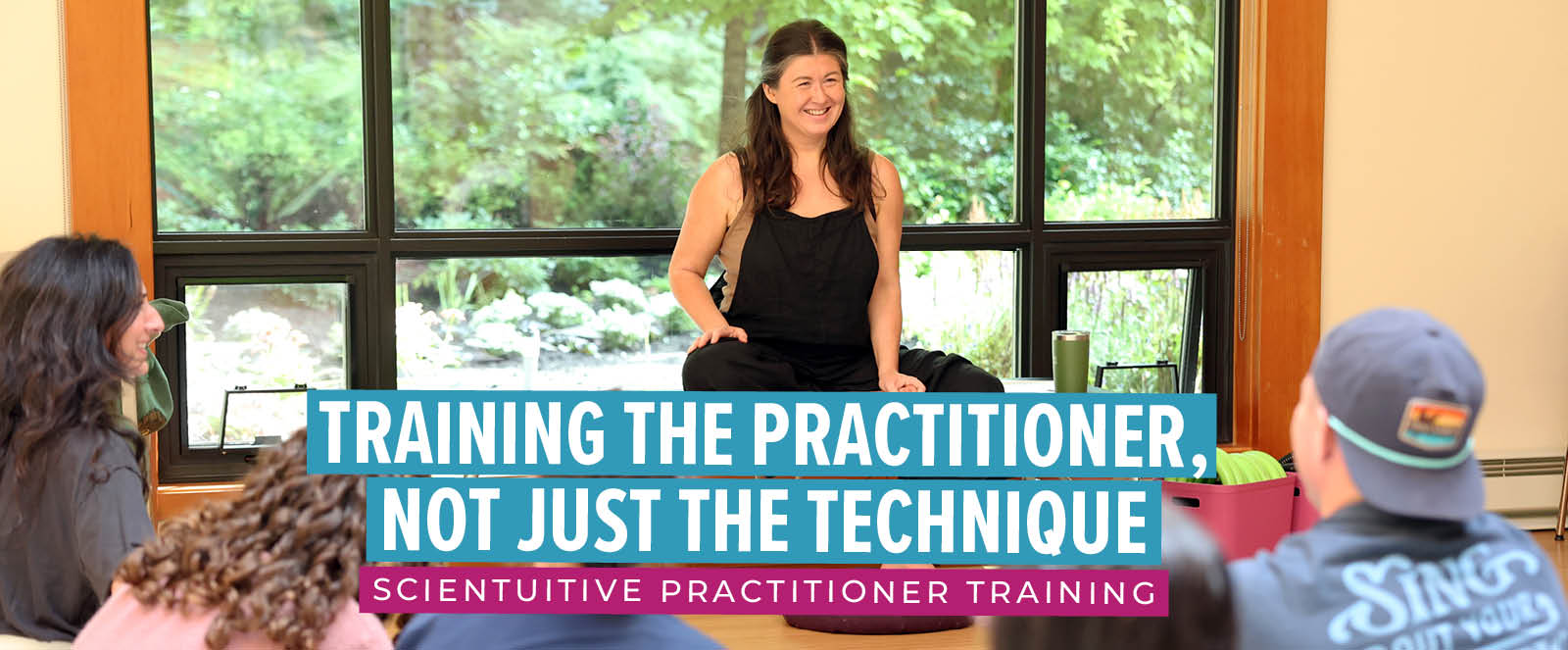
Our first cohort just completed the first level, which was an intensive ten-month commitment that included online and in-person training, along with practicums, theory, group work, guest teachers, and much more.
This week I’ve released a short video that introduces you to what I, and my mentees, have been up to.
In addition to me talking a little bit at the start of the video, my video editor has done a fabulous job piecing together a video compilation showcasing one of our North American retreats (along with some mentees speaking about their experiences).
Even if you are not on the path to becoming a practitioner, I encourage you to have a watch and see what we got up to. Thanks to my husband Seth for composing the musical piece that accompanies the video!
This inaugural mentorship process was a challenging, fun, and rewarding experience for all involved!
A massive thanks to the thirty-one mentees and my staff who trusted me and this new way of practitioner mentorship.
I believe we are making some history here, but time will tell.
Check it out!
There’s a lot of NEW stuff coming your way for the remainder of January, so be sure to visit my Live Events page to see what’s up (and sign up) for one, or more, of the three new events to come.
Thanks everyone for being here, and taking some time to read this important message.
Irene & Team Lyon
PS If you’d like to learn more about the Scientuitive Practitioner Track (SPT) mentorship, have a look.